Cashing in your pension at 50 in Ireland is becoming increasingly common, as more people explore tapping into their share of the €145 billion held in Irish pension assets in 2026.
If you have an occupational or personal pension fund with a former employer, you are likely to be eligible to withdraw a tax-free lump sum of 25% of your retirement savings – as early as age 50.
This guide explores everything you need to know about early pension access rules in 2026, including whether you qualify for early access, and how to access your tax-free lump sum.
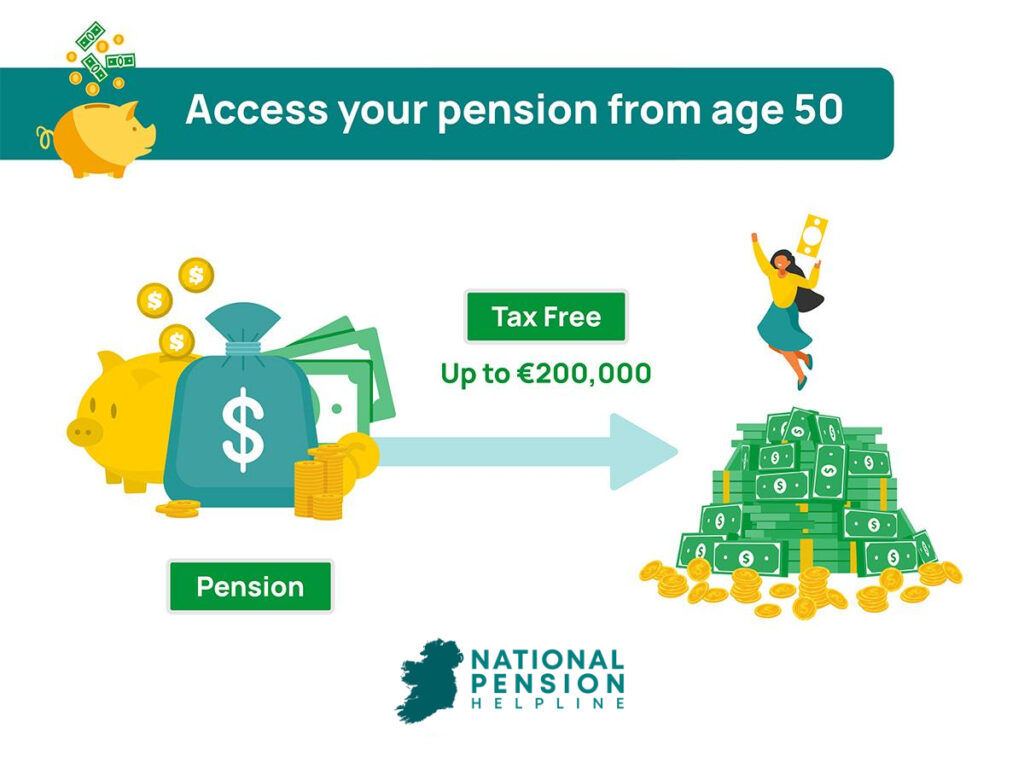
Table of Contents
Can I Cash In My Pension Early at 50?
You can usually cash in 25% of your pension savings tax-free from the age of 50 up to €200,000, as long as you meet certain criteria and your pension scheme is eligible.
If you have a Defined Contribution (DC), Defined Benefit (DB) or an executive pension from a former workplace, or a vested PRSA linked to a former employer scheme, you may qualify for early access from 50.
However, pension funds with your current employer, most PRSAs, and personal pensions (RACs) generally don’t qualify for tax-free lump sums from age 50 – and can usually only be accessed from age 60.
Auto-enrolment workplace pensions, which launched in January 2026, do not qualify for early access and you’ll have to wait until the State pension age of 66.
When it comes to figuring out what type of pension you have, and evaluating the pros and cons of transferring, we strongly advise starting with our online pension transfer assessment and speaking to a qualified financial advisor.
*All consultations are 100% cost free.
Tax-Free Lump Sum Rules 2026
Taking a tax-free lump sum from your pension pot is subject to certain limits and thresholds.
If your pension qualifies for early withdrawal, the current rules allow you to take 25% of your total pension savings, up to a maximum of €200,000. This means if your pension is valued at €800,000, you can withdraw €200,000 tax free.
The current taxation rules on early pension access are:
The following table shows what taking a tax-free lump sum of 25% would look like with different pension pot values.
| Individual | Pension value | Tax-Free Lump Sum (maximum 25%) | Remainder |
| Michelle | €225,000 | €56,250 | €168,750 |
| Brian | €450,000 | €112,500 | €337,500 |
| Pauline | €680,000 | €170,000 | €510,000 |
| James | €800,000 | €200,000 | €600,000 |
| Francis | €1,200,000 | €200,000 | €1,000,000 |
2026 Standard Fund Threshold (SFT) Increase
On 1st January 2026, the Standard Fund Threshold (SFT) increased for the first time in a decade, from €2 million to €2.2 million. This is set to increase each year until it reaches €2.8 million in 2029.
When you ‘crystallise’ your pension, i.e. start withdrawing funds, any pension assets above the SFT are subject to a Chargeable Excess Tax of 40%.
The SFT increases over the coming years particularly affect those with pensions valued at between €2.2 million and €2.8 million. Essentially, you can avoid this additional tax by waiting to cash in your pension until the threshold exceeds your total pension fund.
Despite the changes to the SFT, the maximum lump sum withdrawal that qualifies for full tax relief remains €200,000.
You should also take into consideration the ‘Early Retirement Factor’ – which is that with DB pensions, your annual pension entitlements will be reduced if you take an early lump sum.
Use our personalised Standard Fund Threshold calculator to find out how much tax you will pay if you wish to make early pension withdrawals.
Which pension types can I access early?
Pensions linked to former employers, which are known as preserved pensions, can be accessed early from 50 in Ireland. These include:
The Buy-Out Bond (PRB) Strategy
The Buy-Out Bond or Personal Retirement Bond (PRB) strategy is a common and flexible way of accessing old occupational pensions with former employers.
Because some old DB pensions may be restrictive, transferring your old pension to a Personal Retirement Bond puts you in the driver’s seat with regards to your retirement savings.
A PRB is a straightforward pension plan which you can transfer funds to, allowing you to control your investments and decide how and when to make withdrawals. This includes flexibility around your 25% tax-free lump sum from the age of 50.
Buy-Out Bonds are also a popular method of consolidating multiple pensions into one plan which makes withdrawals easier to manage.
What information do I need in order to cash in my pension early?
The more information you have at hand the better, but the minimum is just your full name, date of birth, a list of companies where you have pensions and the administrator of your pension fund.
If you want to speed up the process, it can also be helpful to have your pension statements on file and your PPS number, although these are not absolutely necessary.
How long does it take to cash in my pension?
On average, it takes between 2 – 4 months to get cash for your pension policy once you have decided you want to access your cash in your pension early.
This timeframe can be extended depending on which company holds your pension (Aviva, Zurich, Irish Life, Standard Life, New Ireland, etc).
The structure of your pension can also cause delays. DB pensions are often the slowest pension to cash out, while employer-linked PRSAs and DC pensions are usually quicker.
Approved Retirement Fund (ARF) vs Annuity
When you cash in your pension, the remainder of your retirement savings are usually transferred to an Approved Retirement Fund (ARF) – which is the most flexible way to access the remaining 75% of your retirement savings.
However, some people opt for an annuity, and there are pros and cons of each of these options.
Tax Incentives of Cashing in My Pension
The main tax incentive of cashing in your pension early is the 25% lump sum that you can take without paying any tax whatsoever, as long as the value of the 25% is below €200,000 (i.e. not your entire pension pot).
However, taking out a higher percentage or more than €200,000 will mean that you have to pay taxes on your withdrawals above these limits.
Any withdrawal from a pension which is either in excess of the 25% tax-free allowance, or in excess of the €200,000 withdrawal cap is known as an “excess lump sum”.
Excess lump sums are taxed at the standard rate of tax (20%) for any amounts between €200,001 and €500,000.
For amounts in excess of €500,000, the withdrawal amount is taxed under the marginal rate of PAYE (40%).
| Lump Sum Amount | Tax Rate |
| Under €200,000 | 0% |
| €200,001 – €500,000 | 20% |
| €500,000+ | 40% |
What Pension Providers Allow Early Pension Access in Ireland?
Pension regulation means that all pension providers in Ireland are required to uphold the guidelines set out by the Central Bank and the Pensions Authority.
| Pension Provider | Cash In Available |
| Irish Life | ✅ |
| Zurich | ✅ |
| Standard Life | ✅ |
| New Ireland | ✅ |
| Aviva | ✅ |
Alternatives to Cashing in Your Pension
Most people jump at the opportunity to take a tax-free lump sum in their 50s if they are eligible to do so.
But deferring your drawdown may be the better option from a tax standpoint if your pension pot is worth more than €2.2 million, as the Standard Fund Threshold is set to increase by €200,000 each January until it hits €2.8 million.
You may also opt to take a staggered approach to your tax-free withdrawals, e.g. take a percentage this year and then another next year – but only if your pension scheme allows for it. With occupational pensions, this may not be an option as they tend to be more rigid than PRSAs or PRBs.
If your pension pot is small compared to your final salary upon retiring or leaving employment, and you have been a member of an occupational pension scheme with over 20 years’ service, you may be able to take a lump sum of 1.5 times your final remuneration.
With this option, you will have to take the remainder of your pension in the form of an annuity – ARFs are not an option.